Tag Archives: mortgage interest rate

What is a Comparison Rate?

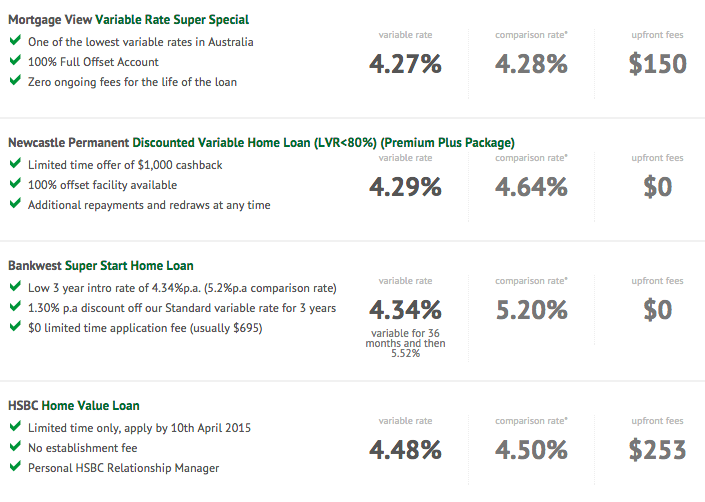
Screen Shot 2015-03-02 at 1.48.05 pm

Comparison rates show that the cost of a loan is greater than just the interest rate. 

I used to think the comparison rate shown by a financial provider was the highest rate with a competing financial provider for the same loan terms, to show how good their rate was. Comparison rates are actually a regulatory requirement for financial providers to supply. So they are not some dodgy rate used to mislead consumers. They actually have a good purpose.

A comparison rate is used for any type of loan; home, car, personal etc, and is a combination of the annual interest rate and the equivalent in fees and charges, taking into consideration the amount borrowed, loan term and the repayment frequency, expressed in a total annual interest rate.

For instance, a $100k loan fixed for 3 years at 4.84% p.a, paying monthly, with a loan term of 25 years may incur fees and charges such as a $600 establishment fee, and a $10 monthly service charge. The interest rate and the equivalent of all of these fees gives a comparison rate of 5.51% p.a.

Basically the 5.51% is comprised of:

  • The annual interest rate of 4.84% for three years, and then a proxy rate for the remaining 22 years of the loan, plus
  • The one off establishment fee of $600, incurred at the start of the loan, plus
  • The $10 monthly service fees, over the 25 year term of the loan, which is 300 payments totalling $3,000, calculated in present value.

Note that there can be many other fees incurred on a loan that are not included in the comparison rate. These fees are not known because they may or may not be incurred, and some examples are: redraw fees, late payment fees, and early repayment fees. Comparison rates also do not include other purchasing fees such as stamp duty, solicitors costs and mortgage registration fees.

The fundamental premise behind comparison rates is sound – it is trying to represent to consumers that the cost of a loan is greater than just the interest rate and quantifying this in an easily comparable way via an “all-in-rate”. The National Credit Code (NCC) enforces comparison rates and “requires that credit providers include a comparison rate when they advertise fixed term credit which is for, or mainly for, personal domestic or household purposes.”

However the problem with comparison rates is that there are so many inputs into the calculation that they are actually very difficult to… compare. When reviewing comparison rate quotes there will always be a footnote, which you should read. It could say something like this “This comparison rate is based on a secured loan of $150,000 over the term of 25 years.  WARNING: The comparison rate applies only to the example given…. Different amounts and terms will result in different comparison rates….” So if you’re looking at borrowing anything other than $150k, for instance, the comparison rate will not be useful. And different lenders can calculate their comparison rate on different loan conditions.

I would suggest speaking to a mortgage broker who can do the leg work for you and find some of the best rates for your situation, understand the different types of fees for each product, and present all of the options to you in a clear way. As always, check how the broker is remunerated to ensure you’re not being sold products they receive more commission on than others.


Cash rate cut by 0.25% to 2.25%

Cash rate graph

Yesterday we saw the first meeting of the year for the RBA and a cash rate cut of 0.25% to 2.25%, the lowest in Governer Glenn Stevens (and many of our) lifetime.

Great news for people holding debt or wanting debt as money will now be cheaper to borrow.

Financial services providers will usually cut their variable mortgage rates as soon as today, with fixed mortgage rates dropping over the next month. See a previous post on how the cash rate drives mortgage rates.

The reason for this rate cut is to stimulate the Australian economy. A number of domestic indicators as well as the continuing state of the world economy has prompted the RBA to support the economy via a boost in Monetary Policy.

Which means things aren’t super great at the moment, but as long as you have your finances in order you can take advantage of this opportunity for cheaper debt.

However the typical trade off for a lower cash rate often is not good for property buyers. The ability to borrow money cheaper, and/or borrow more leads to increased buying demand and therefore competition in the market. And this is from both owner occupiers and even more so, investors.

The market is forecasting another 0.25% rate cut in the first half of this year (at this stage, speculation can change daily). Stay tuned for the next RBA meeting on the 3 March…

Will this property be a home or an investment, now and in the future?

interest-only_1

This is the fourth and final post in my introduction to personal property finance series. A very clever friend of mine commented on a previous post when discussing fixed v variable mortgages, that you can have a number of fixed mortgages. For instance, if you’d decided to fix $150k of your mortgage, you could get 3 x $50k fixed mortgages, which would allow you to repay more principal. Many financial providers restrict the amount of principal you can repay on a mortgage. So if the limit was $10k for mortgage, if you had three fixed mortgages, you could repay $30k of your total $150k fixed mortgage. Splitting your mortgages could also provide more flexibility if you wanted to fix some for one year, some for two years, and so on.

However… this is if you want to repay principal. Many people falsely assume you have to repay your mortgage and that repayments have to include principal and interest (P&I).

Now you’re probably thinking… but then I am not paying down my mortgage and I’m not “getting ahead”, or why would I want to pay the bank all of that interest?, or I thought those sort of mortgages were only for investors… Let me answer all of your concerns and show you that having an Interest Only loan is the best option for you.

First and foremost, your monthly repayments on a P&I mortgage will be higher than Interest Only. On a $100k mortgage where the interest rate if 4.69% and term is 25 years, your P&I repayment is $566.67 (P $175.84 & I $390.83). On the same mortgage, your interest only payment is $390.83. You save $175.84 a month!! When calculating how much you can repay (see previous post “What mortgage payments can I comfortably afford?”), an interest only loan may mean you could comfortably borrow more.

Secondly, if you have an offset account you don’t need to repay principal. See my previous post “What is my risk appetite regarding fixed versus variable mortgages?” for an explanation of offset accounts. If I have a $100k mortgage and $20k in savings in my offset account, this means I only pay interest on $80k. My monthly payments are even less $312.67, and my principal has been reduced by $20k. With a P&I mortgage, I am out of pocket $566.67 in the same month, and I have only repaid $175.84 of principal!! It would take almost 8 years to repay $20k via P&I repayments.

While you are not technically “repaying principal” or “paying off your mortgage” with an interest only mortgage with an offset account, you are reducing the principal amount of the loan, and therefore paying less in repayments.

So maybe you think… well that’s fine but I don’t have a spare $20k to stick in an offset account… even if you only have $1k in your offset and you deposit some small savings each month, you are a lot better off than trying to pay P&I. The more savings you deposit in your offset, the lower your mortgage payments are (incentive!) and you will pay less and less interest to the bank.

The big seller for me on an interest only mortgage with an offset account is the savings you deposit to reduce your principal is YOUR MONEY. You can do with it what you like, you can take it out when you want, and you can put more or less in each month. You can deposit $20k in your offset account and decide a few months later you want to renovate your bathroom. In the meantime you have reduced your monthly payments dramatically AND still have access to YOUR money. If you are repaying P&I, you cannot withdraw that $175.84 of principal. In time you can draw down equity on your home but that is a much more complicated process than transferring some funds from one account to another in your internet banking and hey presto! you’ve got $20k to spend on your renovations.

And finally, the question some people don’t ask themselves when buying a property is… “will I ever rent out this property” …what happens if work posts you interstate, a relative gets sick and you move to care for them, or even that you are lucky enough to buy another property to move into without having to sell the current one… your property could end up being an investment and rented out. If there is any chance this is a possibility, you should strongly consider an Interest Only mortgage as only the interest portion of your mortgage payments will be tax deductible. This leads us into a bigger discussion with regards to “gearing”, which I will cover in the next post.

So really, it’s a no brainer! Interest only mortgages are cheaper, may allow you to comfortably borrow more, with an offset account offer the ability to reduce principal significantly faster than repaying principal each month, and gives you access to that principal any time you want it, all while providing the flexibility for the future with regards to renting the property out as an investment. I promise you’ll be “getting ahead” a lot faster with an Interest Only mortgage.


Note 1: I found a few handy mortgage payment calculators: http://www.planabettermortgage.com.au/loan-calculators/p–i–interest-only.htm or http://www.infochoice.com.au/calculators/principal-and-interest-calculator/


Note 2: There has been vigorous discussion lately from various politicians that they want to get rid of Interest Only mortgages as they think they are contributing to Australia’s property “bubble”, however these mortgages are still widely available.

#7 What is my risk appetite regarding fixed versus variable mortgages?

I was chatting to a friend the other day, who is a very smart person, and she sheepishly admitted she didn’t know what her offset account was for. She knew she had one, she just didn’t know why. It is great she has an offset account, as used effectively these can save thousands of dollars per year. This is where we start discussing how to structure our mortgage to make the most out of our financial situation.

How are interest rates set?

Before we start talking about types of mortgages, let’s talk about interest rates. The interest rate is the cost to you of borrowing money and is quoted on an annual basis. If your interest rate is 4.69% p.a. on a mortgage of $281,000 you pay $13,178.90 per year interest (= 281,000 x (4.69/100)). To work out what this is on a monthly basis, simply divide by 12. For this topic let’s exclude repayment of principal in our mortgage payments, this will be discussed in the next post.

Why is the mortgage interest rate 4.69%? A mortgage interest rate is basically comprised of 2 components:

  1. The cost to your financial provider of borrowing the money in order to lend to you, which is driven by the Reserve Bank of Australia’s overnight cash rate, currently 2.50% (August 2014). The RBA sets this rate on the first Tuesday of every month (except January) based on a number of economic factors to both stimulate and regulate the Australian economy.

This is not exactly what your financial provider pays because it depends on how they borrow the money but if the RBA cash rate is higher, typically it costs more for your financial provider to borrow the money, and vice versa.

The RBA cash rate influences the mortgage interest rate depending on what type of mortgage it is:

  • Variable mortgage rates can change on a monthly (and sometimes more frequently) basis, depending on the move in the RBA’s cash rate. Variable mortgage rates typically move in tandem with the RBA’s cash rate.
  • Fixed mortgage rates are fixed for a time period, for instance one, three or five years. Your financial provider will forecast over this time period how they think the RBA’s cash rate will move and factor this in. For example, if the cash rate is currently 2.50% and the financial provider expects it to gradually increase to 4.00% over the next three years then they will use an average rate for a three year fixed interest rate.
  1. The margin your financial provider charges over and above the cost to them of borrowing the money in order to lend to you. Financial providers are businesses with owners and shareholders so they need to make a profit.

Interest is calculated on the mortgage amount on a daily basis, and varies depending on whether you are also paying down your principal or have an offset account.

Fixed vs Variable mortgages

Basically there are two types of mortgages: fixed and variable. A fixed mortgage locks in an interest rate for a period of time. A variable mortgage interest rate moves in line with the RBA’s cash rate.

The pros and cons of a fixed mortgage:

Pro: You know exactly what your mortgage payments are, which makes it easy to budget for and there are no surprises

Pro: If interest rates increase you are protected from this

Con: A fixed mortgage is locked in for the time period you agree up front. So if the interest rates move significantly against you (i.e. mortgage payments decrease), you decide you want to remortgage with someone else, or you sell your property, you are locked in until your mortgage matures. You can break your mortgage before maturity but the fees tend to be huge, effectively the interest your financial provider would have earned from you for the remainder of the mortgage.

The pros and cons of a variable mortgage:

Pro: You can take advantage of downward moves in the interest rate, i.e. mortgage payments decrease

Pro: You are not locked in to a fixed period of time, and can change from a variable to a fixed loan or a different financial provider with no penalties at any time

Pro: typically variable mortgages can have an optional offset account. An offset account is the home owner’s friend – everyone should have one. See below for more details.

Con: Your mortgage payments can change month by month and could increase significantly

Another consideration is if you expect rates to increase, fixing your rate now can have its benefits. It is hard to forecast the movement of rates with any certainty, so I would suggest speaking to a financial adviser. Bear in mind if your financial provider also expects rates to increase, they may have factored this into the fixed rate anyway. If you expect rates to decrease, a variable rate could be beneficial.

Determining the term of your fixed rate mortgage is important. Do you want your payments locked in for one, two, three… years? Some things to consider:

  • As above, how you expect rates to move. If you think rates will move quickly downwards you may want to fix for a shorter period of time so that you can take advantage of a lower rate sooner,
  • When will you be selling the property? If you plan on selling the property in two years, then fix the mortgage for two years. You will pay significant fees to break a fixed mortgage before it matures, however you may be able to get around this if you buy another property and transfer the mortgage with your financial provider to the new property.
  • Are your circumstances going to change: Will you renovate in a year? Will you be moving overseas soon? Are you planning on having children and one parent going on leave? What suits now may not suit in a few years so you may want your mortgage to mature when your circumstances will likely change so that you can re-assess your position and structure your mortgage differently. Maybe hard to forecast but worthwhile considering.

The Offset Account: everyone should have one

Offset accounts are typically available only on variable mortgages.

Cash deposited in your offset account reduces your mortgage payments. If you have a variable mortgage of $100,000 with an offset account and in that offset account you have savings of $20,000 plus your monthly salary of $3,750 is deposited, this “offsets” or reduces the mortgage amount on which you pay interest:

Mortgage amount        $100,000
Less: Savings                  $  20,000
Less: Monthly salary    $    3,750 (deposited on 1st of each month and drawn upon to pay bills and expenses for the month)
Net mortgage amount  $ 76,250

Monthly mortgage payment on $100,000 at 4.69% = $390.83

Monthly mortgage payment on $76,250 at 4.69% = from $298.01 (depending on when bills/expenses are paid and money is withdrawn)

Saving of $92.82 per month or $1,113.84 per year.

Any cash you deposit in your offset during the month will save you money. The more you deposit the better!

The offset account amount is equal to the variable mortgage amount. In determining how big your variable mortgage should be I think considering how much you can put in your offset account is important. If you have savings of $20,000 and you plan to save more, you might want to make your variable loan (and therefore the offset account size) at least $20,000.

Make sure you get a drawdown facility on your offset account so any funds deposited can be withdrawn if required.

You can have it all: fixed AND variable

There is no right or wrong answer whether you choose a fixed or variable mortgage; there are benefits and negatives to both. What is important to know is that you are not confined to only one type – you can split your mortgage between both fixed and variable. So when you buy your $380,000 property and take on a $281,000 mortgage you could make half fixed and half variable, or any split of your choice.

In addition you can change some or all of your variable mortgage to fixed at any time and when your fixed mortgage matures you can change some or all to variable.

Each financial provider will have different fixed and variable mortgage products with different features so speak to your financial provider or mortgage broker for more details. Speak to your financial adviser to determine the best split between fixed and variable for your circumstances.