
Tag Archives: GFC

The cost of debt and impact on property prices

As interest rates go down, property prices go up

The cost of debt… it sounds like a philosophical question or an attention-grabbing headline on the detrimental cost to society of Millennials living their lives on credit cards and buying too much avocado toast. What I simply mean is “what does it cost to borrow money”? You can borrow money for a variety of reasons however I am referring specifically in this article to borrowing to buy a property, aka getting a mortgage, and how cheap debt pushes property prices up.

If you speak to your bank, a mortgage broker or even type into google “mortgage rate” you’ll be inundated with offerings hovering around 1.8 to 2.2% (October 2021). These are annual percentage rates and simply put, if you had a mortgage rate of 2% you would be paying $20,000 per year on a $1million loan. But where does this magical 2% rate come from and is that high or low?
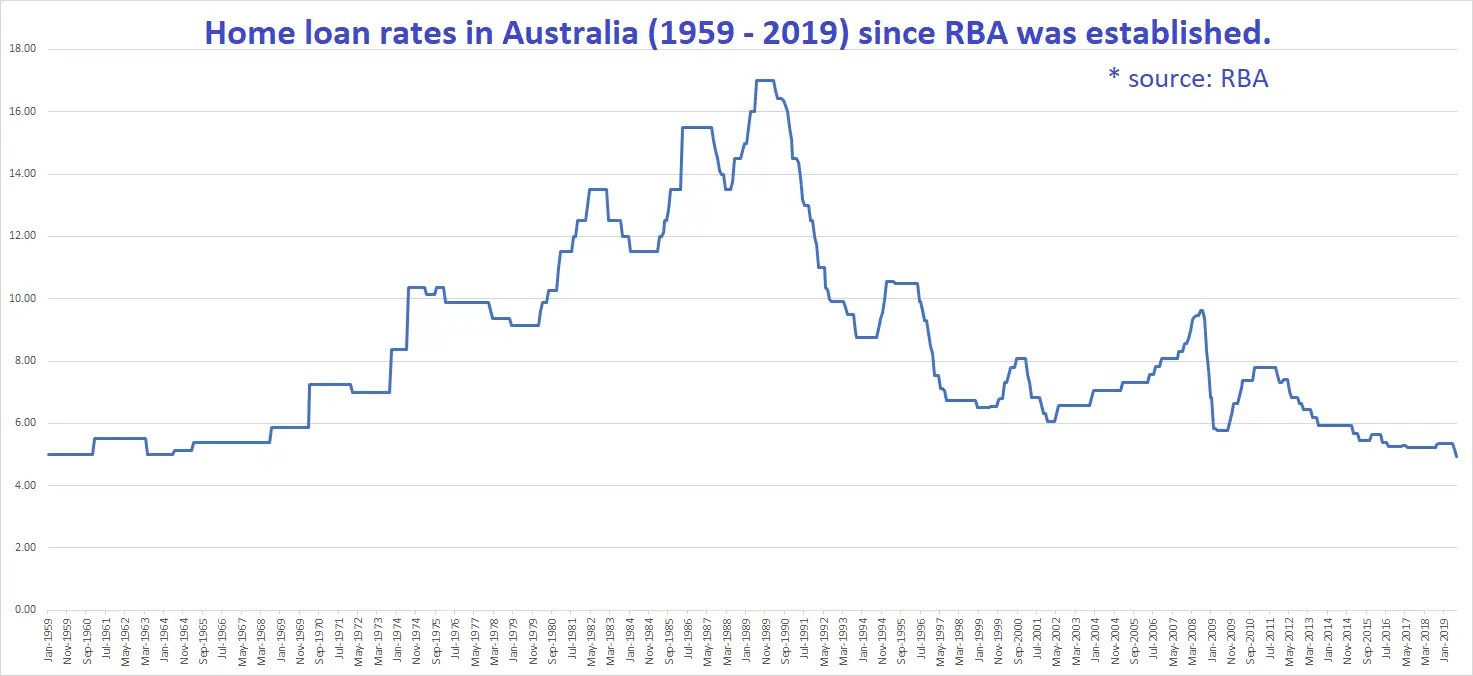
Mortgage rates were highest at 17% in January 1990

To answer the last question first, current mortgage rates are the lowest they’ve ever been. In January 1990 you could have been paying 17% for your mortgage and rates have never really been lower than 5 or 6% even during the Global Financial Crisis in 2008. So, why and how are mortgage rates so low right now? Which leads me back to the first question of how is the rate set?

All interest rates, whether earned on money deposited in a savings account or conversely paid on money borrowed to buy a house, are set off the Reserve Bank of Australia’s (RBA’s) cash rate plus a number of other factors (see previous post here). The RBA announces the new cash rate on the first Tuesday of every month (except January) and weighs a number of economic factors such as unemployment and inflation to determine the rate. The RBA can use the cash rate to influence borrowing or saving to help stabilise the economy.

Currently the RBA cash rate is 0.10%, the lowest it has ever been and almost zero.

If the RBA wants to encourage borrowing the cash rate will be lowered (you pay less interest) and if they want to encourage saving the cash rate will be increased (you earn more interest). Put another way, if the RBA wants people to borrow more they will make it cheaper and easier to do so. But why would the RBA want people to take on more debt?

During the global Covid pandemic with millions of people dying worldwide, billions being locked down for extended periods of time and countless businesses having to temporarily close and potentially going bust, the hit to the global economy has been huge. The Australian economy has been affected by Covid in many ways.

Total unemployment has soared from 5.1% to 7.4% in a five month period

The total unemployment rate has drastically increased from 5.1% just before Covid hit in Feb 2020 to 7.4% in July 2020.

Inflation has sky rocketed in 2021, a direct result of the global pandemic

Furthermore, inflation has gone from around 0% annual inflation in the year ending 2019 to almost 4% in 2020. An increase in inflation is generally a good thing but means the cost of living has increased and the rate at which it has increased during this time is significant. So, less people are employed and it costs more to live. Because of this and many other factors, the RBA is trying to stimulate the economy to spend. And the more we spend the more we borrow.

Therefore, currently you could say the cost of debt is cheap. It does not cost as much as it has done historically (or ever!) to borrow money, and because it is cheap, we can borrow more. For instance, in 2014 the average interest rate was 6%, which on a $1million loan would cost you $60,000 per year. Lending institutions calculate your loan size based on income, current spending habits and a number of other factors. If none of these factors have changed but the interest rate has dropped, because you used to be able to afford $60,000 p.a. on $1million but now it only costs $20,000, the bank is happy to lend you more because you can service a higher level of debt on a lower rate.

And this finally leads me to explain how being able to borrow more money means that buyers can pay more when buying property, which is driving property prices up. If you could only borrow $1million before and a house at auction goes past this point you would have been out. But now you can borrow $1.2million you still have more spending power to stay in the auction. It doesn’t really matter what the property is worth (up to a certain perceived value point), if there are two or more interested buyers with money to spend still interested in buying the property, the price will be set just higher than the lowest bidder’s limit.

The RBA and the government do not want to create a property bubble, nor push prices up any further but these unprecedented times cause for drastic action. Which takes me back to the Millennials at the start of this article and the economic conundrum of housing affordability for the younger generations. Should they stop eating avocado toast and save more, or should the government intervene with drastic changes to the property industry (via duties, taxes, incentives and disincentives)? Or will it be left up to the mums and dads to personally redistribute generational wealth?

#3 How much money can I and should I borrow? Structuring your mortgage and lessons from the GFC.

sp-so-260309-graph1

Structuring your mortgage is, in my opinion, the most important decision with regards to property. Not “what sort of property are we going to buy?”, “where are we going to buy?”, “I really like wooden floorboards, picture rails and open plan kitchens…”. None of that matters until you work out how much you can borrow and how you are going to make that mortgage work for you.

Unless you can pay in cash, all of us mere mortals will require a loan to buy property. And structuring your mortgage does not just apply to when you first buy a property. When your mortgage matures you should revisit this process again because chances are, your circumstances are very different from when you bought 3, 5, or 20 years before.

There are a few key questions you need to ask yourself –

  1. How much cash and/or liquid assets do I currently have?
  2. What mortgage payments can I comfortably afford?
  3. What is my risk appetite regarding fixed versus variable mortgages?
  4. Will this property be a home or an investment, now and in the future?

I will delve into each of these questions in detail in following posts but in a nutshell what we are trying to establish is how much can you afford to borrow and therefore what value property can you buy, in addition to how you borrow that money. And it all comes down to thorough analysis, planning and understanding your risk appetite.

Does this all sound like gobbledy gook? I promise if you keep reading, all of the mysteries of mortgages will be explained plainly and simply and you’ll be quoting the latest variable interest rates in no time!

So, back to risk. Risk is all about how much you like living life dangerously, and in this case with regards to debt. Wild! If you are risk averse you buy a modest family home that does not stretch you financially and you work hard to pay down the mortgage as soon as you can so that your debt is minimised. An admirable and respected approach that probably a few more people should take. If you are a risk seeker you may stretch yourself to your financial limit to buy multiple investment properties with a lot of debt in the hope you can make a quick buck and sell them on with a good profit in a short period of time. Also perfectly acceptable, provided you have done thorough research.

Which leads me onto the Global Financial Crisis (GFC) – which hit the world in late 2007 with its effects still reverberating today. Economies have experienced many an upturn and downturn, with some saying cycles tend to last approximately 10 years, but due to business’ increasingly borderless and global nature, the recent downturn has had the furthest reaching effects worldwide and on a scale not seen before.

So how does the GFC affect us normal people with mortgages, jobs and the daily grind? Breaking it down in simple terms, it’s all about not being able to pay your mortgage when the going gets tough.

During the early 2000’s property values were increasing steadily year on year. Some would say owning property was a license to print money. Financial lenders cottoned onto this trend and started offering bigger and bigger mortgages and at Loan-to-Value ratios (LVRs) of up to 110%. An LVR of 110% is where you don’t need a deposit or any further savings to pay for initial costs such as solicitor’s fees, taxes and duties. So for a house worth $500,000 you could get a loan for $550,000 with absolutely no savings to your name. Sounds crazy, doesn’t it?

The financial services industry then did some crazy stuff on a large scale with these fairly risky and sometimes not very secure mortgages by trying to sell them on as A grade premium on the basis that property prices would just keep going up. After a while people started to realise these mortgages weren’t quite what they seemed and the house of cards came tumbling down.

Over time property values started plateauing and then decreasing and a combination of two things happened: (1) the economy was negatively affected by property values declining and people started losing their jobs and therefore were unable to pay their mortgages, and (2) the value of a property no longer covered the value of the mortgage and financial lenders started pulling back on lending, which made getting a mortgage more difficult and so less people were buying these houses that the people who lost their jobs now couldn’t pay for. What a snowball effect!

The lessons to be learnt from this latest financial crisis are that property values do not always increase, and that we should not borrow more than we can afford, regardless of what the bank is willing to lend. And importantly that this is one of many financial crises that have occurred and will occur again. Property, and the economy in general, is cyclical – there are always periods of incline followed by periods of decline. So let’s buy that property, be it grand or modest, a family home or a fixer-upper, and let’s stretch ourselves only to the point where if the world went into crisis again, we wont be caught with our proverbial pants down.

Stay tuned for question number 1. How much cash and/or liquid assets do I currently have?