Category Archives: Uncategorized

Lockdown and virtual property auctions

Covid lockdowns have brought many unforeseen changes to the way we live our normal day to day lives. In person property auctions are prohibited and virtual auctions are the temporary norm. The property industry has had to pivot and find a new way to conduct business, especially during the current property boom.

You may ask, why would anyone want to buy or sell property during the pandemic and especially during lockdown, but life must go on. You may have listed a property then the city goes into lockdown, another baby on the way makes the need for more space time critical, or you may just be sick of living, working and exercising in the same home every day because of lockdown and need a change. The resilience and perseverance of many businesses and society to keep moving forward and living life as best as we can during Covid is inspiring.

Properties can be sold (called private treaty) or auctioned in Australia but where the area or property is in high demand it usually goes to auction. Certainly, in inner city Sydney, which is a very competitive property market, most properties will go to auction, and across Australia approximately one quarter of properties are sold via auction.

I attended countless auctions when I was trying to buy a property over 12 years ago in Sydney. There were massive turnouts, usually standing in front of the property in the street or squeezed inside the living room, with every inquisitive neighbour and passer-by also attending. The bidding was competitive and intimidating, and everyone had eyes on the potential buyers vying for a chance to secure the property before they reached their absolute (top top, maybe just a tad more!) maximum spending limit. I tried to buy at a few auctions when I thought I had a chance but was always outbid, eventually thankfully buying by private treaty.

The start of a virtual property auction with the auctioneer presenting and the bidding activity read to start below

At a virtual auction you are sitting in front of a computer looking at a live video of the auctioneer and underneath are are the live bids including the Bid, Bid Amount and Bidder (identified only by a number), with the latest bid at the top. You don’t know who the other bidders are, what they look like, are they old or young, are they single, couple, family, downsizers, and most importantly do they look like they have more money than me…? And bidders only participate by submitting a bid electronically, there is no noise aside from the auctioneer’s voice, who operates in much the same way as at an in-person auction.

Buyers who are interested in attending a virtual auction must electronically pre-register. This provides an interesting indicator in the lead up to an auction of how many buyers are seriously interested, whereas at an in-person auction you only need to register when you arrive. Of course, a registered bidder might not log in on the day, nor even place a bid, but 2-3 registered bidders is a good number, 6-8 is great and anything above that is excellent. This is vastly different from some in-person auctions I attended with literally 60-70 spectators and who knows how many bidders.

I had my reservations of the process, and as a seller was seeking the atmosphere and buzz from an in-person auction, hoping that would spur on the competition. However, my agent, who was absolutely amazing and patiently held my hand (figuratively of course, social distancing rules apply!) throughout the whole campaign, explained the unexpected benefits of this new process.

All in-person auctions would usually be scheduled on a Saturday but because everyone is at home sitting in front of a computer in lockdown, virtual auctions can be held any day of the week (usually Wednesdays to Saturdays) and interest for mid-week auctions versus the traditional Saturday is much higher. There is a captive audience just waiting for something exciting to do during their lockdown day.

Sometimes in a fierce bidding war it’s hard to hear and keep up with the bid and who is still bidding but the history of bids on the screen in front of you makes it very neat and organised. You can clearly see which bidders are currently participating, which may have dropped out and who is bidding in large jumps to tactically scare other buyers away. Adding a timestamp to the bids would be useful to track the flurries and pauses. It also saves a poor junior agent, just starting their career, having to frantically jot down these bids on a notepad as they are made.

While I prefer to see and size up my competition, some buyers may welcome the anonymity and controlled environment of a virtual auction. Tech savvy buyers in the younger generations are completely comfortable with virtual auctions. However there has been reservation from the older generations and on occasion these buyers request agents bid on their behalf or perhaps shy away from the process.

During an in-person auction I had always noticed the agents sidling up to bidders and whispering in their ear, trying to gauge their interest, encourage bidding and squeeze every last cent. I wondered how this would work in a virtual auction but agents are usually on text or phone call with the bidders (and seller) throughout the process so this line of communication is potentially enhanced while open conversations can be held in private. Bidders can simply not answer the phone or texts however, so this is not entirely fool-proof.

In terms of the feared lack of buzz I was very wrong. With the sole focus on those bids climbing up, with nothing but your budget and the latest bid in front of you, the process hones focus to the auctioneer and the number at the top of the list. If enough serious bidders attend (you only need two keen ones!) this alchemy creates some very fierce competition. As a buyer I would say your usual auction strategy is still very much applicable for a virtual auction – know your budget and be confident.

I asked my agent if virtual auctions will continue after lockdown life given their success but he predicts not. There is just nothing quite like the experience of an in-person auction. I wonder if auction apps will be designed to facilitate digital pre-registration and bidding during future in-person auctions, mixing elements of all methods and bringing the auction process into the digital age.


Its been a big week for the cash rate…

down-arrow

Not only did the Reserve Bank of Australia (RBA) drop the cash rate by 25bps to 1.50% (to even further historical lows) on Tuesday 2 August but the Bank of England (BoE) also dropped the cash rate by 25bps to 0.25% today, Thursday 4 August. Its been a big week for the cash rate globally.

Today the BoE cash rate cut was hardly a surprise with the devastating market effects from the EU referendum. The referendum was held on 23 June for the public to decide whether to remain in the European Union, an economic and political partnership between european member countries to foster economic co-operation. Since the UK joined the EU 43 years ago there are 28 member countries and in this time only two countries had left (Greenland in 1985 and Algeria in 1962). Since the referendum global markets went into shock significantly impacting currency and asset values.

The BoE has not cut the cash rate since 2009 during the credit crunch and since then global economies still have not recovered to levels prior. The BoE is trying to stimulate the economy and mitigate some of the referendum impacts, implying a downturn was inevitable without monetary policy changes. Stay tuned for further cuts.

The RBA cut the cash rate this week to promote sustainable growth in the economy while inflation returns to target, citing the global economy is growing at a lower than average pace. One of Australia’s main export is commodities, of which prices have been in decline for years. In addition, China’s lower than expected growth impacts Australia as a major trading partner. The Labour market shows mixed results with business investment significantly down. So not one or two major and/or new factors but just a general continuing of growth lower than expectations has prompted the RBA to further stimulate the economy. I wouldn’t expect another cut in September but there could be a further cut by the end of the year.

Once again, a lower cash rate is good for borrowers via cheaper debt but not good for savers (especially retirees) with lower interest income earned.

Keep your eye on the US election on 8 November, which could have far reaching impacts on all major economies depending on the outcome…


An introduction to the London property rental market

London coloured houses

While I have been battling the sleepless minefield of having a newborn and a toddler my poor husband has been in London for his new job. While it seems he should be having the best time sans wife and kids (and of course he has been enjoying himself, not least of which includes attending the Aust v Wales Rugby World Cup match!), he has had to find us a rental house. And wow it seems the London property rental market is tough!

You can start by looking at the online property websites (similar to domain.com and realestate.com in Australia) http://www.zoopla.co.uk and http://www.rightmove.co.uk. But as we discovered, a lot of the properties listed have already been rented, a lot of the properties don’t even get listed on these sites, and if the property is any good, won’t even have time to be listed. The best advice we got was to register interest with the good real estate agents in the areas you wish to rent. Then they have met you, know your story, have a personal connection with you, and when a property that fits your criteria becomes available, they can call you to discuss.

You have to figure out where you want to live. Luckily my husband and I have both lived in London, so know some areas really well. We also asked friends for recommendations for good “family” areas in London, because we sure didn’t take notice of those in our 20s! And then we had the debate whether we live in London (borough) or Greater London (in the other 31 boroughs extending to Twickenham, Croydon etc). We decided if we were moving to London, we wanted to live in London and we would forgo space and a backyard for proximity!

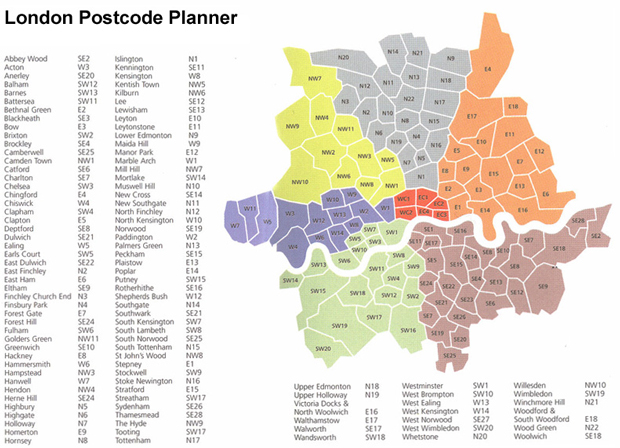
Understanding the postcodes in London may seem daunting at first but is really easy. Postcodes start with a compass location; North, South, East and West, and are then followed by a number indicating proximity to the centre. Postcodes centre on the “City of London”, officially Charing Cross Station (WC1). The central postcodes are given a “C” reference and are only East (“EC”) and West (“WC”). You then move out from these central postcodes to postcodes starting with simply “N” for north, “NW” for northwest, “S”, “SW” “E”, and “W”. An example being N1 for Islington, which is north of the City of London and very close, to SW20 for West Wimbledon, which is southwest of the City of London and the furthest postcode before you move out of the London borough .

london-postcode-guide

Geeking out here, UK postcodes are brilliant because with just the street number and the full postcode, you can find an exact location in the whole of the UK. A full UK postcode will firstly identify which area in the whole of the UK (not just London) and then the street and even the side of the street. So for example “SW1 2AA” tells me SW1 is Victoria/Westminster and 2AA is Downing Street. So if I add the number 10 I will find my way to David Cameron’s house. Love it!

Most importantly you really need to work out your budget. The research I did suggested London rents can cost 30-50% of your net income. Apparently some credit agencies will advise landlords against leasing to tenants where the rent is greater than 30% of gross income. I thought this sounded quite high and we would pay nowhere near that much, but on one income (until I return to work next year) and needing 3 bedrooms, we are definitely pushing our upper limit. Then you have to factor in those unexpected UK charges of TV Licence fees (what the?!) and Council Tax (equivalent of Council Rates, paid by the landlord in Australia), and of course transport charges depending on which zone you live in.

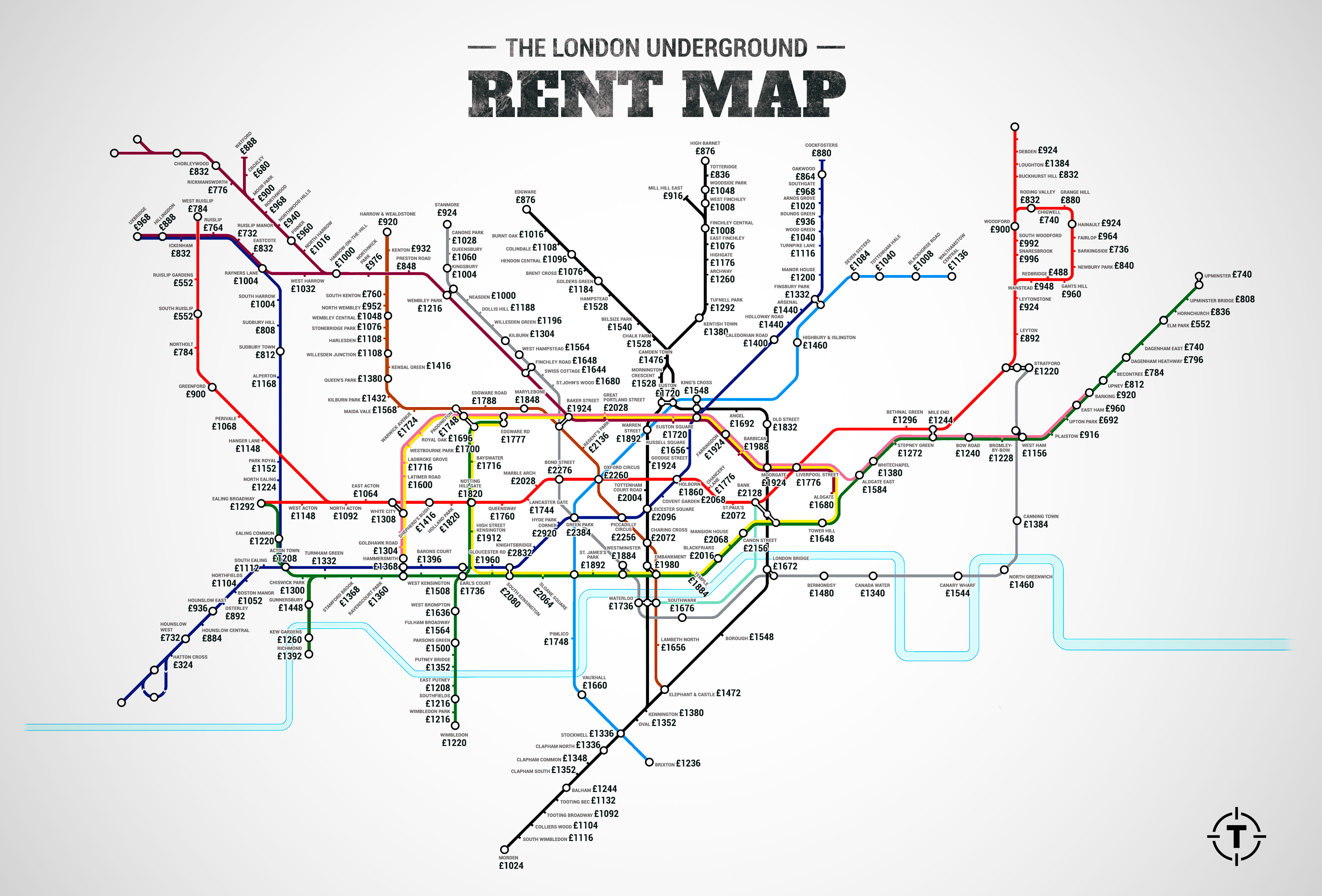
London rental map

This picture shows a great comparison of the rental costs in London. I’m not sure if the amounts are current but if you’re comparing areas, this is pretty spot on!

Then be prepared for the competition! The rental market is fierce and prospective tenants regularly offer more rent in order to secure a property, and good properties often get leased within days. So you have to be all over it like a fat kid on a cake, and be prepared to pay up for a property you really love.

Because we now have kids and things such as health and wellbeing now rank so much higher than where the best pub is, I wanted to understand where one lives in London in relation to levels of pollution. Luckily I have a cousin who is a Paediatric Allergist in London and she simply advised against living on main streets, suggesting even just one street back from a main street has no more pollution than the next big city.

So take the time to understand the areas in which you want to live. Spend a Sunday walking these areas and discovering on which streets you’d like to live. Especially work out how close your nearest underground or overland station is, and how you get to work and other regular haunts.

And finally, the best advice I got when moving over in 2006, which is still relevant, was to live where you friends live. Even though the transport system in London, while sometimes unreliable, is one of the best in the world, you don’t want to live in SW15 if all of your friends live in N19.

And just as a final note, we discovered that properties with 3+ bedrooms tend to be unfurnished. We thought we would easily find a furnished house and only ship over our personal items but this does not seem to be the case. So either be prepared to ship over your furniture, or buy when you get there.

We settled on a lovely 3 bedroom house in Wandsworth, close to Wandsworth Town overland station, and within budget! We move in late November. I haven’t lived in a rental for over 7 years so that will be a bit weird again!