
Category Archives: Renting

An introduction to the London property rental market

London coloured houses

While I have been battling the sleepless minefield of having a newborn and a toddler my poor husband has been in London for his new job. While it seems he should be having the best time sans wife and kids (and of course he has been enjoying himself, not least of which includes attending the Aust v Wales Rugby World Cup match!), he has had to find us a rental house. And wow it seems the London property rental market is tough!

You can start by looking at the online property websites (similar to domain.com and realestate.com in Australia) http://www.zoopla.co.uk and http://www.rightmove.co.uk. But as we discovered, a lot of the properties listed have already been rented, a lot of the properties don’t even get listed on these sites, and if the property is any good, won’t even have time to be listed. The best advice we got was to register interest with the good real estate agents in the areas you wish to rent. Then they have met you, know your story, have a personal connection with you, and when a property that fits your criteria becomes available, they can call you to discuss.

You have to figure out where you want to live. Luckily my husband and I have both lived in London, so know some areas really well. We also asked friends for recommendations for good “family” areas in London, because we sure didn’t take notice of those in our 20s! And then we had the debate whether we live in London (borough) or Greater London (in the other 31 boroughs extending to Twickenham, Croydon etc). We decided if we were moving to London, we wanted to live in London and we would forgo space and a backyard for proximity!

Understanding the postcodes in London may seem daunting at first but is really easy. Postcodes start with a compass location; North, South, East and West, and are then followed by a number indicating proximity to the centre. Postcodes centre on the “City of London”, officially Charing Cross Station (WC1). The central postcodes are given a “C” reference and are only East (“EC”) and West (“WC”). You then move out from these central postcodes to postcodes starting with simply “N” for north, “NW” for northwest, “S”, “SW” “E”, and “W”. An example being N1 for Islington, which is north of the City of London and very close, to SW20 for West Wimbledon, which is southwest of the City of London and the furthest postcode before you move out of the London borough .
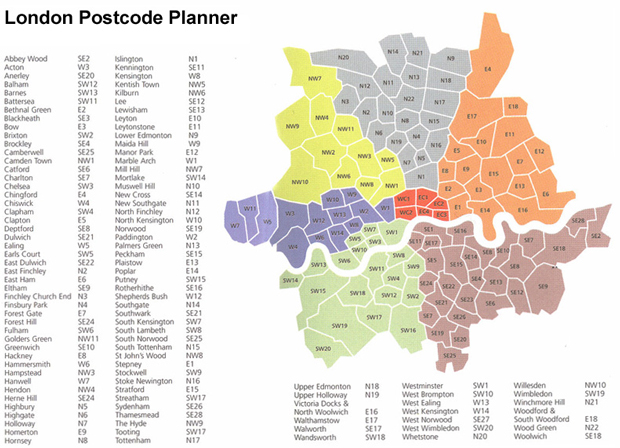
london-postcode-guide

Geeking out here, UK postcodes are brilliant because with just the street number and the full postcode, you can find an exact location in the whole of the UK. A full UK postcode will firstly identify which area in the whole of the UK (not just London) and then the street and even the side of the street. So for example “SW1 2AA” tells me SW1 is Victoria/Westminster and 2AA is Downing Street. So if I add the number 10 I will find my way to David Cameron’s house. Love it!

Most importantly you really need to work out your budget. The research I did suggested London rents can cost 30-50% of your net income. Apparently some credit agencies will advise landlords against leasing to tenants where the rent is greater than 30% of gross income. I thought this sounded quite high and we would pay nowhere near that much, but on one income (until I return to work next year) and needing 3 bedrooms, we are definitely pushing our upper limit. Then you have to factor in those unexpected UK charges of TV Licence fees (what the?!) and Council Tax (equivalent of Council Rates, paid by the landlord in Australia), and of course transport charges depending on which zone you live in.
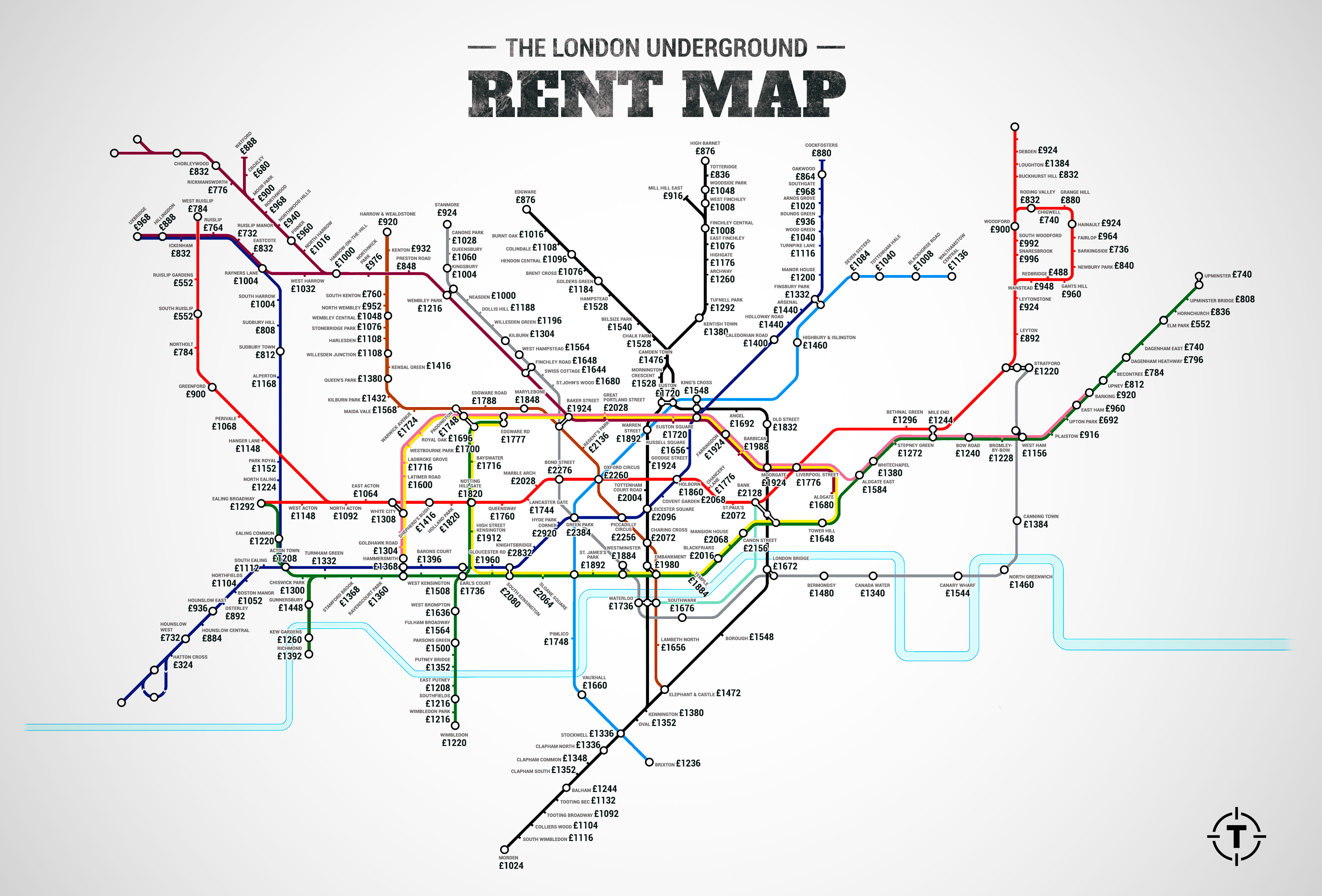
London rental map

This picture shows a great comparison of the rental costs in London. I’m not sure if the amounts are current but if you’re comparing areas, this is pretty spot on!

Then be prepared for the competition! The rental market is fierce and prospective tenants regularly offer more rent in order to secure a property, and good properties often get leased within days. So you have to be all over it like a fat kid on a cake, and be prepared to pay up for a property you really love.

Because we now have kids and things such as health and wellbeing now rank so much higher than where the best pub is, I wanted to understand where one lives in London in relation to levels of pollution. Luckily I have a cousin who is a Paediatric Allergist in London and she simply advised against living on main streets, suggesting even just one street back from a main street has no more pollution than the next big city.

So take the time to understand the areas in which you want to live. Spend a Sunday walking these areas and discovering on which streets you’d like to live. Especially work out how close your nearest underground or overland station is, and how you get to work and other regular haunts.

And finally, the best advice I got when moving over in 2006, which is still relevant, was to live where you friends live. Even though the transport system in London, while sometimes unreliable, is one of the best in the world, you don’t want to live in SW15 if all of your friends live in N19.

And just as a final note, we discovered that properties with 3+ bedrooms tend to be unfurnished. We thought we would easily find a furnished house and only ship over our personal items but this does not seem to be the case. So either be prepared to ship over your furniture, or buy when you get there.

We settled on a lovely 3 bedroom house in Wandsworth, close to Wandsworth Town overland station, and within budget! We move in late November. I haven’t lived in a rental for over 7 years so that will be a bit weird again!


We are packed!

cardboard box london bus

…well sort of! The packers came today to pack the items we are putting in storage for our move to London. Yes we’re going back. Albeit much older and with two kids.

The last year has been a little hectic, to say the least. I’ve thought of posting nearly every day but hadn’t the time or the motivation to write during what spare time I had. After moving in after renovations and needing a break from that *insert expletive here* experience, we then got pregnant, had our second child and are relocating to London next week for work.

To catch up, it seems we have reached the peak of the property market (I’d like to suggest my last post predicted this), and the cash rate is still 2%. I think the RBA is enjoying the pressure the banks are putting on borrowers with recent rate rises due to higher capital charges (which I can explain, if anyone’s interested?). Markets are calling for the RBA to cut rates to combat this but in actual fact it’s pressuring the housing price boom down and doing the RBA and the Government’s job for them.

So step one in our packing is complete… next stage is packing what we will take on the plane (I have investigated EXACTLY how many kgs we can take!), what will be air freighted (80kg, which takes 8-9 days), and what will be shipped (which takes 8-9 weeks). And with kids this is no mean feat. Because kids need a LOT of stuff. Their 59 million favourite soft toys (“I want Ferdinand, and Elephante, and SheepDog, and and and”), 376,000 favourite books (“I want Chutney, and Marshmallow Mouse, and Cars Cars Cars and and and”) and 39 vehicles of all description (“I want Fuoco Motore x 3, Orange Car, Porsche, Digger Digger Digger!”). And that’s just the toddler. And they can’t wait for these favourite, precious, must-have-immediately things for 8-9 days for the air freight arrive. So I have been weaning our toddler off lots of toys onto just a few key ones. Thankfully our baby doesn’t need many toys but she needs loads of other things; blankets, nappies (!!), wraps etc etc etc.

So my plan is to effectively pack our bags a few days before we go and weigh them to within an inch of their life. Then pack the airfreight and do the same. Then everything has to go on the slow boat and we’ll just pretend we’re camping. First world problems!!

Thankfully we are being properly relocated with work, so we have packers, shippers, temporary serviced accommodation when we arrive, relocation services helping with finding permanent accommodation, rental furniture while ours arrives, visas etc etc etc. And then there is the list of things we have to do in Oz before we leave…

Rent our house – this friends is one of the reasons you shouldn’t pay off principal on your mortgage (see previous post here). Sell our car. Organise the new baby’s birth certificate and passport, adding her to Medicare, private health insurance and applying to schools, because god knows I’ll forget to do that when we move and by the time we get back in a few years she won’t be able to get in anywhere for high school and the poor thing will be desperately deprived for life (note the sarcastic parental guilt). Cancel utilities, phones, remove ourselves from the electoral roll… the list goes on!

Plus did I mention we just had a baby?!

I still have loads to write about the Sydney property market, renovating and everything property, but will also be adding some insights on London property too. Next post is about the London rental market.

So we leave next Thursday. Wish us luck in our final week!!


Gearing: understanding the buzzword

97

Gearing relates to how you structure the financial position on an investment property (or any income producing asset). You can be positively, neutral or negatively geared.

I have a friend who has some big ideas on property, some of which are great and others I question whether he is regurgitating buzzwords without necessarily understanding what they mean. My friend wants to buy an investment property and negatively gear it, but what he hasn’t considered is that negative gearing requires a cash outflow on his part, and when he isn’t in a surplus cash position to start with this could be a financial burden. “Negative Gearing” is a big tax buzzword but for most normal people it can live up to it’s name and just be… negative.

Negative Gearing

Negative gearing is where expenses outweigh income. For example, you own an apartment with a mortgage that you rent out. Typical expenses would be, for example:

$    1,200 / mth mortgage payments (assume interest only)

$     800 / qtr strata fees

$    1,000 / yr council rates and water bills

$     500 / yr occasional repairs and maintenance

$     300 / yr rental agency fees

$19,400 annual expenses

You receive rent of $350 per week, which is $18,200 of annual income. Therefore the property costs you a loss of $1,200 per year. This means you have to spend $1,200 of your own cash each year on this property.

There are two main reasons why people chose to negatively gear:

  1. They are high-income earners who are looking for a tax deduction. The cash outlay of $1,200 will be used to offset against their income to lower their tax obligations. For the highest earning tax bracket this means they will receive a credit against their tax of $588 but the net effect is they still need to outlay $612 cash against the property. Great for someone who has lots of cash.
  1. They are hoping that the capital gain on the property will outweigh the costs of negatively gearing it. For instance, the apartment cost you $380k to buy and if you sell in three years time for $430k, less stamp duty, selling agency fees etc you have made a gain of approx $20k, of which you can keep just over half after paying your tax bill, which means for $1,836 cash outlay, you have made a net gain of $8,164 (which is not a great return, but that’s for another post!).

All good reasons to negatively gear, but if you don’t have surplus cash, are not on a high tax rate and/or expect some capital growth in the property regardless, negative gearing might not be for you.

Neutral Gearing

This is where you manage the expenses and income of the property to effectively net out to zero.

I have chosen this option in the past because I wanted my investment property to just “pay for itself” while it grew in value.

Positive Gearing

This is where you want to earn an income from your property. Great if you don’t earn a salary, i.e. you’re a non-working parent, or you are retired and are living off your assets.

This is where the rental income on the property is greater than the expenses. You may pay tax on the net income earned (depending on your overall tax position), but you will be receiving income and therefore a cash inflow.

Before I went on maternity leave I prepaid a year of mortgage repayments on the investment loan on my mortgage to bring forward greater expenses in the year I was still earning a wage (i.e. the property was negatively geared in that year). The year I wasn’t earning an income while on maternity leave my property was positively geared, which provided a small but helpful income. So you can change your gearing depending on your situation.

So please don’t get caught up in buzzwords like “negative gearing” without fully understanding what they mean to you. If anyone has any other buzzwords they would like clarification on, please include in the comments below…

Will this property be a home or an investment, now and in the future?

interest-only_1

This is the fourth and final post in my introduction to personal property finance series. A very clever friend of mine commented on a previous post when discussing fixed v variable mortgages, that you can have a number of fixed mortgages. For instance, if you’d decided to fix $150k of your mortgage, you could get 3 x $50k fixed mortgages, which would allow you to repay more principal. Many financial providers restrict the amount of principal you can repay on a mortgage. So if the limit was $10k for mortgage, if you had three fixed mortgages, you could repay $30k of your total $150k fixed mortgage. Splitting your mortgages could also provide more flexibility if you wanted to fix some for one year, some for two years, and so on.

However… this is if you want to repay principal. Many people falsely assume you have to repay your mortgage and that repayments have to include principal and interest (P&I).

Now you’re probably thinking… but then I am not paying down my mortgage and I’m not “getting ahead”, or why would I want to pay the bank all of that interest?, or I thought those sort of mortgages were only for investors… Let me answer all of your concerns and show you that having an Interest Only loan is the best option for you.

First and foremost, your monthly repayments on a P&I mortgage will be higher than Interest Only. On a $100k mortgage where the interest rate if 4.69% and term is 25 years, your P&I repayment is $566.67 (P $175.84 & I $390.83). On the same mortgage, your interest only payment is $390.83. You save $175.84 a month!! When calculating how much you can repay (see previous post “What mortgage payments can I comfortably afford?”), an interest only loan may mean you could comfortably borrow more.

Secondly, if you have an offset account you don’t need to repay principal. See my previous post “What is my risk appetite regarding fixed versus variable mortgages?” for an explanation of offset accounts. If I have a $100k mortgage and $20k in savings in my offset account, this means I only pay interest on $80k. My monthly payments are even less $312.67, and my principal has been reduced by $20k. With a P&I mortgage, I am out of pocket $566.67 in the same month, and I have only repaid $175.84 of principal!! It would take almost 8 years to repay $20k via P&I repayments.

While you are not technically “repaying principal” or “paying off your mortgage” with an interest only mortgage with an offset account, you are reducing the principal amount of the loan, and therefore paying less in repayments.

So maybe you think… well that’s fine but I don’t have a spare $20k to stick in an offset account… even if you only have $1k in your offset and you deposit some small savings each month, you are a lot better off than trying to pay P&I. The more savings you deposit in your offset, the lower your mortgage payments are (incentive!) and you will pay less and less interest to the bank.

The big seller for me on an interest only mortgage with an offset account is the savings you deposit to reduce your principal is YOUR MONEY. You can do with it what you like, you can take it out when you want, and you can put more or less in each month. You can deposit $20k in your offset account and decide a few months later you want to renovate your bathroom. In the meantime you have reduced your monthly payments dramatically AND still have access to YOUR money. If you are repaying P&I, you cannot withdraw that $175.84 of principal. In time you can draw down equity on your home but that is a much more complicated process than transferring some funds from one account to another in your internet banking and hey presto! you’ve got $20k to spend on your renovations.

And finally, the question some people don’t ask themselves when buying a property is… “will I ever rent out this property” …what happens if work posts you interstate, a relative gets sick and you move to care for them, or even that you are lucky enough to buy another property to move into without having to sell the current one… your property could end up being an investment and rented out. If there is any chance this is a possibility, you should strongly consider an Interest Only mortgage as only the interest portion of your mortgage payments will be tax deductible. This leads us into a bigger discussion with regards to “gearing”, which I will cover in the next post.

So really, it’s a no brainer! Interest only mortgages are cheaper, may allow you to comfortably borrow more, with an offset account offer the ability to reduce principal significantly faster than repaying principal each month, and gives you access to that principal any time you want it, all while providing the flexibility for the future with regards to renting the property out as an investment. I promise you’ll be “getting ahead” a lot faster with an Interest Only mortgage.


Note 1: I found a few handy mortgage payment calculators: http://www.planabettermortgage.com.au/loan-calculators/p–i–interest-only.htm or http://www.infochoice.com.au/calculators/principal-and-interest-calculator/


Note 2: There has been vigorous discussion lately from various politicians that they want to get rid of Interest Only mortgages as they think they are contributing to Australia’s property “bubble”, however these mortgages are still widely available.

A Love Letter to Millers Point

Millers Point 1

I have been walking around the Rocks and Millers Point for the last five years. I am in awe of the heritage landscape, capturing what I imagine Sydney truly looked like in it’s early colonial, convict days. Old police station buildings with intricate stone facade, original pubs in beautiful condition you can almost see the ghosts still lovingly cradling their pints in both hands, and rows and rows of the most phenomenal terrace houses unlike anywhere in Sydney.

OLYMPUS DIGITAL CAMERA

I think I am blessed to work in Sydney city and in my lunch hours take advantage of the beautiful sunshine to walk around these historical places, passing right under the Harbour Bridge, walking beside Sydney Harbour with full view of the Opera House and straight into these quiet pockets of history a mere 20 minutes from my office building. Millers Point especially is like a different world with its beautiful large houses and stone buildings. Almost no traffic passes through here, it is not on-the-way to anything, and very few people wander the streets.

I have often thought given the size of the houses and the quiet nature of the area, coupled with the amazing views across the Harbour and the proximity to the CBD, living in Millers Point would be wonderful, even to raise a family. I would stare longingly into the empty windows of the grand terraces, admiring the original floor boards, the sheer size of the rooms and the preservation of original features and wonder how much it would cost to buy one.

I was vaguely aware of some mid 80’s low rise apartment blocks and townhouses that were Government housing but I had no idea some of the beautiful terraces were Government housing too. I just though the area was living up to its ghost town vibe, with potential residents possibly put off by the Government housing neighbours. I hardly ever saw these tenants.

That is why I am so surprised to learn that the Millers Point Community, the vast majority of which are Government housing tenants, are in an uproar about the Government selling off these amazing houses. What “community”? I have never seen people walking their dogs in the street, kids playing in the park, or old codgers hanging outside the pub having a smoke and reminiscing about old times.

I understand the Government housing tenants are upset they have to move, and no doubt to a far less prestigious and sensationally located suburb than Millers Point, but it comes down to the simple economics of supply and demand.

The market value of these houses are in the millions of dollars as discovered from the recent sale of a few of the long uninhabited houses, which indicates the Government housing tenants could not afford to buy their homes. In addition, the value of these houses means the rent would be exorbitant and therefore also unaffordable. But not just to the Government housing tenants, but most normal people! Millers Point and its houses are hot property. Estimates predict the Government could make up to $500 million on the sale of these houses. Think of the social projects they could invest in with that sort of money. It is smart for the Government to sell off a small number of non-producing assets and release this capital for better use.

On one of my walks I saw a billboard with some stories of these tenants and reasons why they should not leave.

One tenant claims no-one wanted to live in Millers Point 30 years ago. To that I say, times change. Millers Point was inevitably going to attract interest, it is incredible it has taken this long. And a 30 year tenancy is unheard of! The Government housing tenants have been lucky to have lived in in the one house for so long.

Another tenant stated they were settled in Millers Point in 1981 when they immigrated to Australia. What luck they had! When my mum immigrated to Australia in 1949 she and her family were settled outside Parramatta in an immigrant area built with tin houses, otherwise known as “Silver City”. My grandma never moved far from there, working herself to the bone to eventually afford a small house in St Mary’s, from where she finally moved into a nursing home 50 years later.

What I would love to see is Millers Point re-energised. Those beautiful houses open and aired and lived in, children running up and down the halls, dogs barking in the yards. Restoration of the rundown heritage properties to their former glory. Life on the streets! People sipping piccolos in cafes, sitting in the parks admiring the priceless views, talking to and laughing with eachother, neighbours borrowing a cup of sugar. If that means the Government housing tenants are relocated and these beautiful heritage homes sold to the highest bidder, so be it. Because the Government housing tenants have done nothing for the community that I can see, and Millers Point is too beautiful and interesting to be left languishing. Bring on the gentrification!

millers_point 2